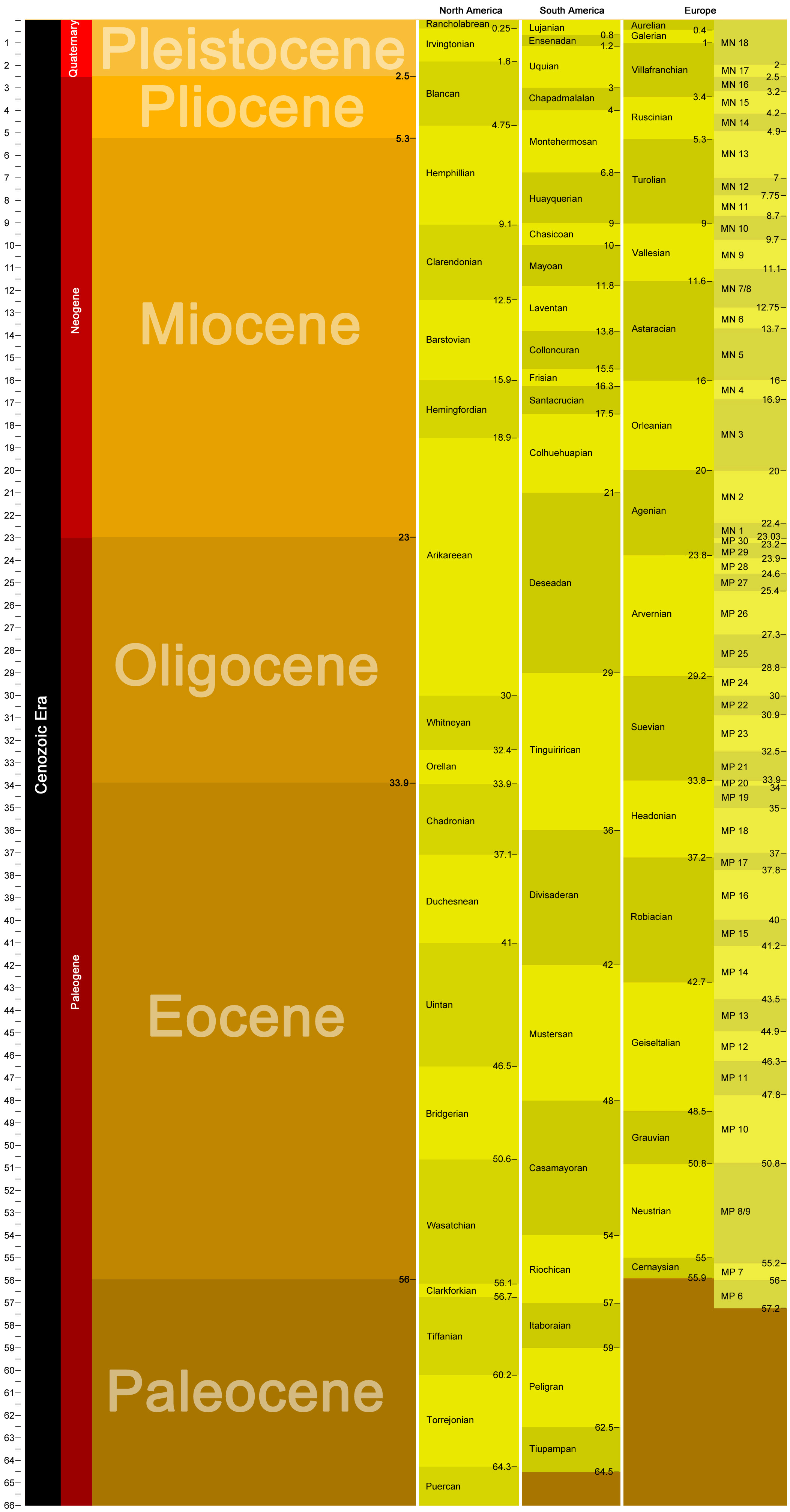
The Cenozoic Era is the most recent stage of the broader Phanerozoic Eon. It is the period of geologic time which immediately follows the Mesozoic Era, spanning from 66mya (mya = million years ago) to present day. The word Cenozoic is derived from the Greek words cainos and zoe, literally meaning “New Life”. Indeed, the era has hosted a huge variety of animals to fill the void left over by the extinction of the non-avian dinosaurs; most notably the mammals. This period is commonly referred to a “The Age of Mammals” due to the group having such a dominating presence in most of the world’s ecosystems.
Biochronology
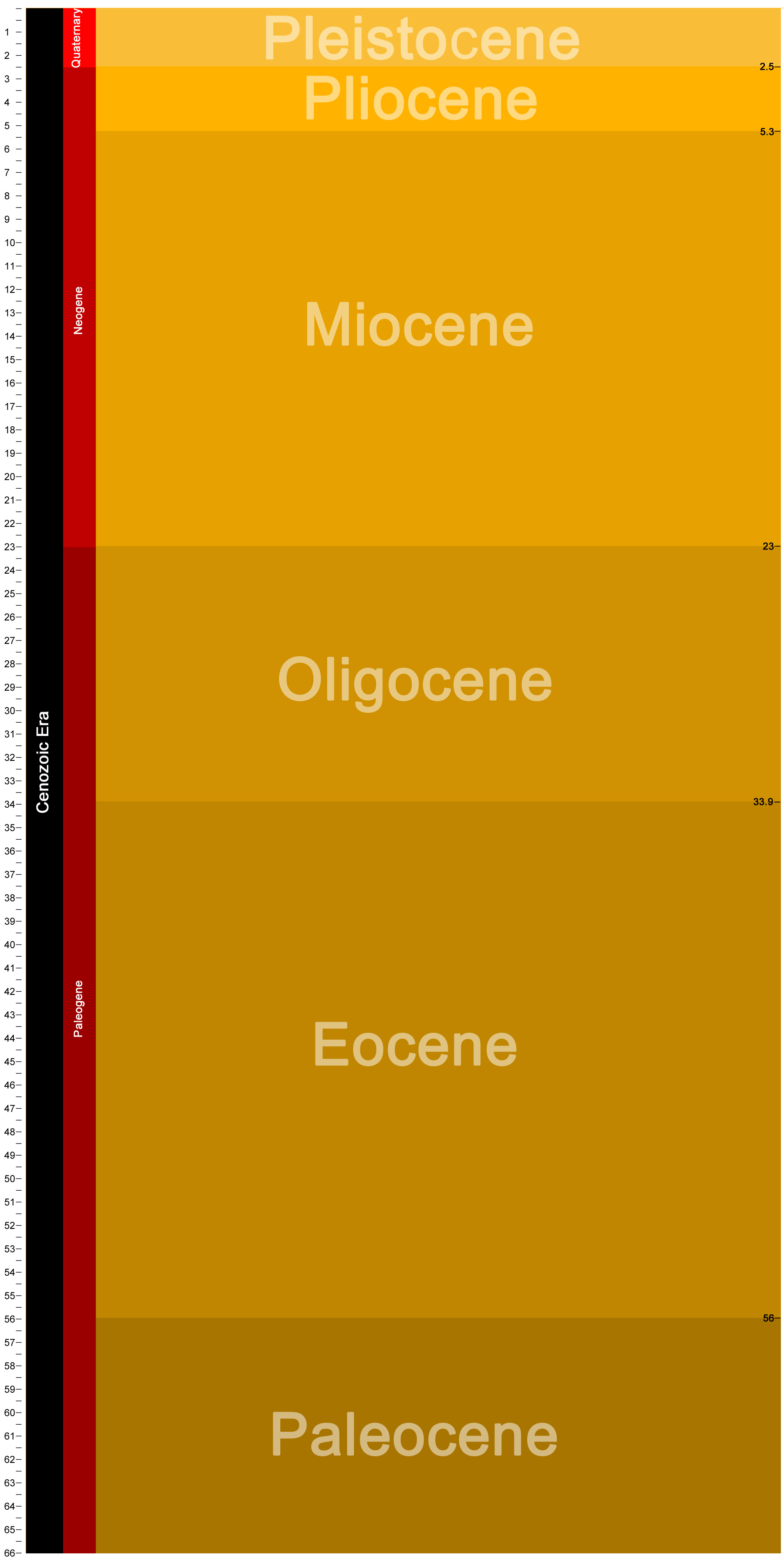
The Cenozoic era is divided into three periods: Paleogene, Neogene, and Quaternary. Each of these is, in turn, subdivided into seven smaller units known as epochs: Paleocene, Eocene, Oligocene, Miocene, Pliocene, Pleistocene, and Holocene.
Land Mammal Ages
The epochs are broad spaces of time; up to 18 million years in the Miocene and as little as 13,000 years for the Holocene. For this reason, when discussing organisms or events within these epochs it is often useful to subdivide these into “early”, “middle”, and “late” intervals to be specific. To be even more precise, however, paleontologists often use another set of terms to refer to geologic time within epochs: Land Mammal Ages (LMAs). LMAs are intervals of geologic time within epochs that are characterized by a distinctive set of mammals for a particular geographic region, usually entire continents. Likewise, there are different sets of LMAs for North America, South America, Australia, Asia, and Africa. A functionally similar system is used in Europe but with a different style of terminology and names. The mammalian fossil record is useful in estimating time because mammals are abundantly preserved in most places, many lineages have a relatively rapid evolutionary rate, and their teeth are anatomically complex enough to allow the recognition of distinct species